
The conventional financial narrative is simple: work a job, put your savings into an index fund or blue-chip compounder, don’t touch it, and let time do the heavy lifting.
The poster child for this philosophy is almost always Warren Buffett. The public imagines a calm, grandfatherly figure reading annual reports in Omaha, buying Coca-Cola or Apple, and sitting on his hands for thirty years.
Compounding over decades is undeniable math, but it ignores an essential question: Where did the initial critical mass of capital come from?
If you start with $10,000 and compound at an exceptional 10% per year, after 30 years you have roughly $174,000. That is wealth preservation; it is not financial freedom.
When you study the early careers of the world’s most legendary financial figures, you discover a very different reality: they generated velocity through active trading, arbitrage, and tactical turnarounds first. Only after they had accumulated massive scale did they pivot to passive, long-term holding.
1. The Early Buffett Was Not a "Buy-and-Hold" Investor
Between 1956 and 1969, running the Buffett Partnership Ltd., Buffett generated annualized returns of over 29% without a single losing year.
He didn’t do that by buying great companies at fair prices and holding them forever. He categorized his portfolio into buckets that look far more like an event-driven hedge fund than a retirement account:
- Work-Outs (Risk Arbitrage): These were corporate spin-offs, mergers, reorganizations, and liquidations. Buffett bought securities whose payoff depended on corporate actions rather than market direction. He bought, captured the spread, closed the position, and redeployed the capital—classic short-term trading.
- Generals (Cigar Butts): Deep-value equities priced below their net working capital (net-nets). He held them until they had a 30% to 50% pop, dumped them, and searched for the next one.
- Control Situations: Buying enough shares to force management to liquidate or pay out hidden assets (which is how he originally took over Berkshire Hathaway, then a struggling textile mill).
Early Buffett was obsessed with capital turnover. If a trade hit target value in six months, he didn't hold it for another ten years hoping for miracles; he sold it to capture the internal rate of return (IRR) and recycle the cash into the next edge.
2. Size Is the Enemy of Trading Performance
Why did Buffett transition away from fast-turnover arbitrage and into holding consumer monopolies forever?
He answered this himself: sheer size.
When managing $500,000, you can buy tiny micro-cap companies trading at discounts to book value, or execute small arbitrage plays where liquidity is thin. When managing $500 billion, those trades become mathematically irrelevant.
A $50 million position moving 100% does virtually nothing to move the needle on Berkshire’s massive balance sheet today. At that scale, an investor is forced to become an owner of entire companies or massive public giants simply because there is nowhere else to put the cash without moving the price against themselves.
3. The Other Giants Followed the Same Playbook
Buffett is far from the only legend whose public image diverged from his wealth-creation playbook:
- Carl Icahn: Started as an options broker on Wall Street, learning volatility, pricing skew, and leverage before becoming an activist corporate raider.
- George Soros: Built his foundation through macro trading—exploiting currency mispricings, debt imbalances, and regulatory policy shifts with high leverage and tight stop-outs.
- Ray Dalio: Founded Bridgewater as an active commodities and interest-rate trading advisory shop before institutionalizing the "All Weather" risk-parity portfolio.
In each case, asymmetric, active risk-taking established the war chest. Long-term asset allocation became the tool to protect it.
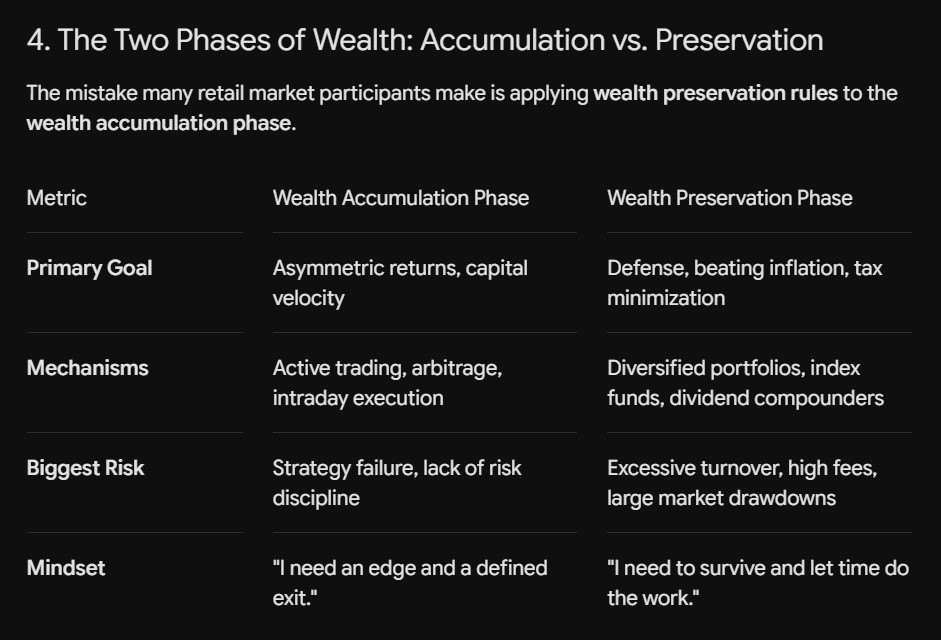
When financial media tells someone with a $15,000 account to "buy quality and never sell," they are giving institutional advice to an individual who needs capital velocity.
Trading—whether futures, equities, or options—is not passive. It demands strict execution, stop-loss adherence, and ruthless discipline. But it provides something long-term investing cannot: the ability to extract cash flow from market volatility regardless of whether the macro environment is in a multi-year bull or bear cycle.
Treat Trading as the Foundation
Investing long-term is essential for keeping what you make. But believing that the world's greatest fortunes were built purely by buying stocks and forgetting about them ignores market history.
Master the mechanics of price action. Respect your downside risk. Learn to pull liquidity from the market systematically. When your active edge builds your base, you will have earned the right to sit back and let long-term compounding handle the rest.
References & Further Reading
The historical shift from active trading to passive holding is well-documented in the letters and biographies of these financial titans. If you want to study the mechanics of their early wealth accumulation, start here:
- The Buffett Partnership Letters (1957–1970): Buffett’s original letters to his early partners outline his exact strategies for wealth accumulation before Berkshire Hathaway. He explicitly breaks his portfolio down into "Generals" (undervalued stocks), "Workouts" (risk arbitrage and special situations), and "Control" situations. Read the archived letters here.
- Berkshire Hathaway 1989 Shareholder Letter: Warren Buffett explicitly discusses his transition away from "cigar-butt" investing (buying struggling companies at a steep discount to liquidate or flip) into buying wonderful businesses at fair prices, noting that scale forced his hand. Read the 1989 letter here.
- "Size is the anchor of performance": In a famous 1999 interview with BusinessWeek, Buffett admitted that a massive capital base prevents high-velocity returns. He stated: "It's a huge structural advantage not to have a lot of money. I think I could make you 50% a year on $1 million. No, I know I could. I guarantee that."
- Carl Icahn’s Origins: Before becoming a feared corporate raider and long-term activist holder, Icahn began his career on Wall Street in 1961 as an options broker and developed early proprietary arbitrage strategies. His transition from short-term arbitrage to long-term activism is heavily documented in financial history.
- Ray Dalio & Bridgewater’s Trading Roots: Before launching the passive-leaning "All Weather" portfolio that retail investors know today, Dalio started Bridgewater Associates in his apartment as a daily advisory service for corporate clients trying to manage active currency and commodity market risks.
Disclaimer: Tradoer Inc and its operators are not financial professionals, registered advisers, brokers, or commodity trading advisors. Historical analysis and commentary do not constitute investment advice or a promise of returns. Trading futures and equities involves substantial risk of loss. Full legal disclaimer at tradoer.com/legal.